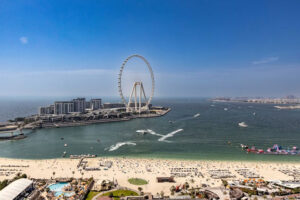
An aerial view of a beach with a ferris wheel, Ain Dubai, Bluewaters, Dubai, UAE. Credit: Unsplash/Nelemson Guevarra
By Maximilian Malawista
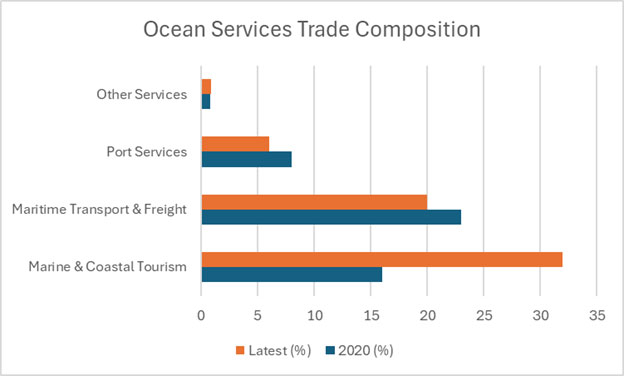
UNITED NATIONS, Jun 12 2026 – The global ocean economy continues its expansion, with ocean-related trade reaching USD 2.5 trillion as of 2025. Ocean services now make up the majority of the ocean trade, accounting for 58.9 percent of the composition, up from 47.8 percent in 2020.
Ocean services alone are now valued at USD 1.44 trillion dollars, an increase of USD 1.2 trillion since 2020; a rate greater than the entire global ocean trade in 2020. While 2020 was a year filled with disruptions, economies contracting, and consumer smoothing, this number is an increase of USD 476 billion dollars since 2015, a 49.5 percent growth from 2015, where the ocean services trade generated USD 961 billion.
“The ocean economy is expanding rapidly across sectors such as aquaculture, tourism, and shipping. While this growth is vital for food security, employment, and economic development, it’s increasingly constrained by the declining health of the ocean,” said Rafael González Quiroz, co-director of the United Nations ‘Third World Ocean Assessment’ and director of Spain’s Oceanographic center of Gijón (IEO-CSIC), during a press briefing held on World Ocean Day (June 8).
The UN World Ocean Assessment is a global integrated assessment of the world’s ocean following environmental, economic and social aspects, with interdisciplinary inputs from more than 650 experts to provide scientific basis for the consideration of ocean issues by governments and policy makers, among other stakeholders involved in the regulation and protection of the ocean.
Quiroz’s assessment reflect the broader expansion and changes within the ocean economy, where services have an increasingly dominant role in the global ocean economy. The strongest example of such is the recovery of marine and coastal tourism, which has turned sharply since the 2020 COVID-19 pandemic.
Credit: IPS/Maximilian Malawista
Today, marine and coastal tourism now accounts for 32 percent of global ocean trade, up from 16 percent in 2020. 32 percent representing USD 785 billion, over half of all ocean services trade. Maritime freight transport remains the second highest, at roughly USD 487 billion or 20 percent of total ocean trade. Quiroz emphasized that a “sustainable ocean economy can only exist if it’s built upon a healthy and resilient ocean”.
One of the key challenges highlighted during the briefing was marine pollution, especially plastics. Within global plastics trade, only 10 percent of all plastics are recycled. 52 million tonnes of such plastic waste every year enters the ocean, which the United Nations states is affecting at least 4,000 marine species.
In response, the international community has spent the past six years working on negotiating a “global plastics treaty”, an agreement which would put a ceiling on plastic production, and limit the USD 1.1 trillion dollar industry, ensuring waste management standards, recycling requirements, and creating market space for sustainable alternatives.
Achieving this may require changes to global trade incentives. UN Trade and Development (UNCTAD) finds that “the key barrier is an uneven national and trade policy field.”
According to UNCTAD, tariffs on plastics have fallen from 34 percent to 7.2 percent over the past 3 decades, giving plastic producers a larger incentive to keep making more plastic. While plastic tariffs have decreased, alternatives to plastics like bamboo, natural fibers, paper, and seaweed have had tariffs double to the rate of 14.4 percent. As a result of such tariffs, conventional plastics remain the cheaper option for manufacturers.
However, recent volatility in the energy markets stemming from the current Strait of Hormuz crisis has increased the cost of plastic production. Reports from UNCTAD show that because plastics are approximately 98 percent derived from fossil fuels, the cost of plastic prices has risen 70-80 percent in the European markets. This market shock could open the door for sustainable alternatives, giving real reason for companies to develop products free of polyethylene resin and other plastics, further developing the sustainable alternatives industry.
IPS UN Bureau Report
!function(d,s,id){var js,fjs=d.getElementsByTagName(s)[0],p=/^http:/.test(d.location)?’http’:’https’;if(!d.getElementById(id)){js=d.createElement(s);js.id=id;js.src=p+’://platform.twitter.com/widgets.js’;fjs.parentNode.insertBefore(js,fjs);}}(document, ‘script’, ‘twitter-wjs’);