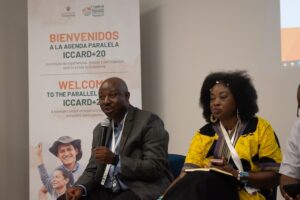
From the left, Rev. Tolbert Thomas Jallah Jn with Mariann Bassey Olsson during the launch of the campaign in Cartagena, Colombia. Credit: AFSA.
By Isaiah Esipisu
NAIROBI, Apr 14 2026 – Over 800 households in Ikolomani Constituency in Kakamega County, Western Kenya, fear eviction to pave the way for a British firm, Shanta Gold Limited, to begin extracting gold valued at Sh683 billion ($5.29 billion) on an estimated 337 acres of residential and agricultural land.
Efforts by residents to protest against the looming displacement during an attempt for a public participation session on the Environmental and Social Impact Assessment (ESIA) by the government on 4 December 2025 were met with police brutality, leading to four deaths due to bullet wounds, arbitrary arrests and scores of injuries.
According to the Kenya Human Rights Commission (KHRC), the incident is part of a disturbing and escalating pattern in Kenya’s extractive sector, where communities seeking accountability are met with brutal force, political threats, and procedural manipulation.
“Mining zones are increasingly becoming death traps rather than engines of community development,” reads part of a statement issued by the commission following the incident.
This trend mirrors what is happening in many other countries across Africa, where communities living in mineral-rich areas face forceful displacements, abuse of basic human rights, and environmental degradation linked to industrial mineral extraction, often perpetrated by foreign firms with full support of the political class.
According to Appolinaire Zagabe, a Congolese human rights activist and the Director for the DRC Climate Change Network (Reseau Sur le Changement Climatique RDC) in the Democratic Republic of Congo (DRC), often, people he terms ‘greedy government officials’ sign contracts with extractive firms to legalise their activities, then use police machinery to forcefully and brutally evict communities without informed consent and proper compensation.
It is based on such injustices that civil society organisations, social movements, faith-based actors, Indigenous Peoples, pastoralist and peasant organisations from Africa under the umbrella of the Alliance for Food Sovereignty in Africa (AFSA) launched a campaign calling for land policies that protect African smallholder farmers and communities against punitive extractive practices and land grabbing, which are currently a threat to human rights, livelihoods and sustainable food systems.
“Land is more than a resource; it is our heritage, our identity, and our future,” said Rev. Tolbert Thomas Jallah Jr, the Executive Director at the Faith and Justice Network, during the launch of the campaign on the sidelines of the International Conference on Agrarian Reform and Rural Development (ICARRD+20) in Cartagena, Colombia.
“Across Africa, our soils feed our families, sustain our economies, and connect generations, yet today, land degradation, industrial extractive practices by foreign enterprises, climate change, and land grabbing threaten the very foundation of our food systems,” he added.
In a joint declaration at the conference, the organisations observed that rural communities across the world continue to face dispossession, land concentration, and ecological destruction.
“Despite global commitments to end hunger and poverty, land and food systems are increasingly controlled by corporate and financial interests, while communities that produce food remain marginalised and insecure,” reads part of the declaration statement.
It was further observed that carbon offset projects, extractive industries, agribusiness expansions, and speculative land markets are accelerating dispossession, soil degradation, and social inequality, often excluding communities from territories they have governed collectively for generations.
The campaign, dubbed “Protect Our Land, Restore Our Soil”, is now calling on governments to strengthen land rights and protect smallholder farmers; communities to embrace sustainable farming practices that rebuild soil fertility; and youthful farmers to view agriculture not as a last resort but as a powerful pathway to innovation and resilience.
“When soil is degraded, food becomes scarce, and when land is taken or misused, communities lose dignity and security,” said Rev. Tolbert, who is also the sitting Chairperson at the AFSA’s Board of Directors.
Just like the looming evictions of residents of Ikolomani in Kenya, Amnesty International has also observed that people of the DRC also pay a high price to supply the world with copper and cobalt: forced evictions, illegal destruction of their homes, and physical violence – sometimes leading to deaths.
The DRC supplies 70 to 74 percent of the copper and cobalt used in lithium-ion batteries. These batteries power our smartphones, laptops, electric cars, and bicycles, and they play a major role in the energy transition away from fossil fuels. This transition is urgent and necessary.
However, according to Amnesty International, mineral-rich regions of the DRC are sacrificed to mining development, leading to a shocking series of abuses in the region. Thousands of people have lost their homes, schools, hospitals, and communities due to the expansion of copper and cobalt mines in the country, especially in Kolwezi, which sits above rich copper and cobalt deposits.
The AFSA-led campaign calls on governments and corporate organisations to guarantee meaningful participation of affected communities and free prior and informed consent of Indigenous Peoples in land, agriculture and climate decision-making to avoid conflicts and abuse of basic human rights.
“The future lies not in further commodifying land and food systems, but in restoring community control over territories, securing pastoralist mobility and commons, and supporting agroecological transitions rooted in justice and ecological integrity,” observed Mariann Bassey Olsson, a Lawyer, and Director at Action (Friends of the Earth Nigeria).
IPS UN Bureau Report
!function(d,s,id){var js,fjs=d.getElementsByTagName(s)[0],p=/^http:/.test(d.location)?’http’:’https’;if(!d.getElementById(id)){js=d.createElement(s);js.id=id;js.src=p+’://platform.twitter.com/widgets.js’;fjs.parentNode.insertBefore(js,fjs);}}(document, ‘script’, ‘twitter-wjs’);
